
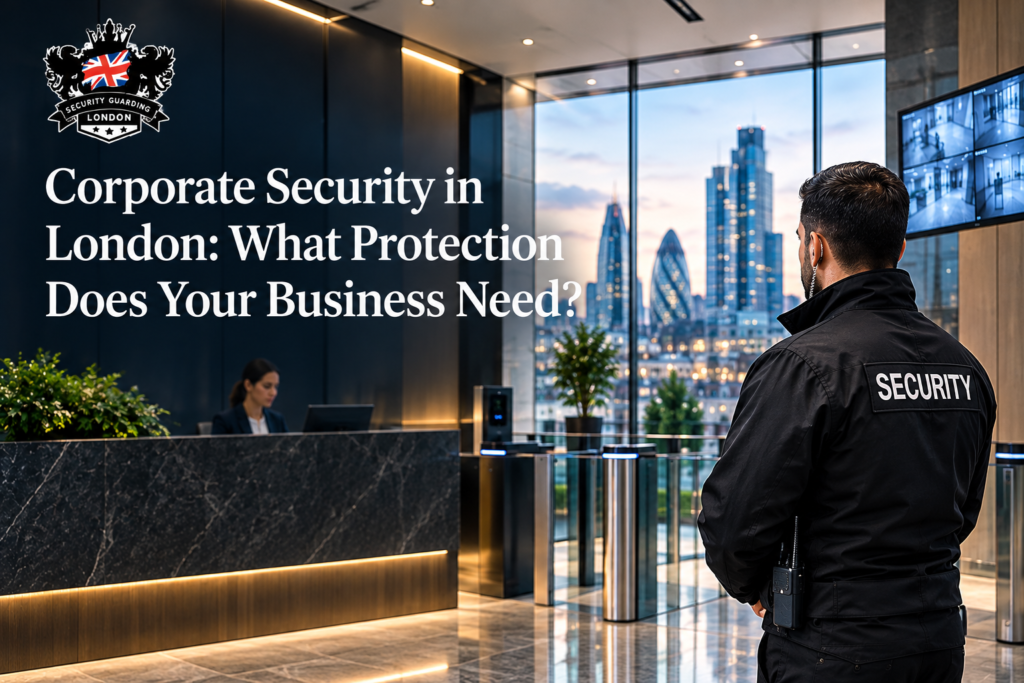
London businesses face physical, operational and people-related risks. For office managers, directors, facilities teams and property owners, corporate security in London is not simply about placing a guard at reception. It involves getting to know the site, figuring out the areas you are most vulnerable in, and then implementing only what is proportionally necessary for protection.
The right approach depends on your premises, workforce, visitors, hours, assets and existing controls. A financial office may need discreet access management, while a larger site may require patrols, CCTV and response support.
Why Do London Businesses Need Corporate Protection?
Corporate premises can contain valuable equipment, sensitive information, stock and confidential documents. Different entrances, different people coming in including the ones doing the contract works, the visitors and the fact that there are different working times create openings for unauthorized entrance and then things like theft, defacing of property or causing some trouble.
As per the Office for National Statistics report, 19% of businesses experienced at least one cybercrime in the year ending March 2026. While cyber protection needs specialist digital controls, the figure reinforces the need to treat security as a business risk.
Physical security cannot prevent every threat, but it adds a trained human layer to observe activity, manage access, respond and escalate concerns.
What Should Corporate Security In London Cover?
There is no universal checklist. A corporate security London plan should start with the risks specific to your premises.
- Access Control
Reception and entry points are often the first line of the security strategy. Officers will be able to verify that only the allowed personnel and visitors enter, to monitor deliveries and to question any suspicious situations. Clearly defined and communicated protocols also prevent employees from being confused and contractors from feeling uncertain.
- Manned Guarding
Corporate security services may include static guarding, mobile patrols or a combination of both. Static officers can provide a consistent presence at entrances, while mobile patrols can cover larger sites and identify issues away from reception areas.
- CCTV and Incident Monitoring
Though CCTV systems provide an extended view area, the value of closed-circuit television can be maximised when human expertise is available for observation and taking action based on what is displayed on the monitors.
- Key Holding and Emergency Response
Key holding and alarm response can reduce the need for employees to attend alarm activations themselves and provide a structured response outside normal hours.
How Many Corporate Security Guards Does Your Business Need?
There is no fixed staff-to-building ratio. Consider entrances, site size, operating hours, visitor volume, high-value areas, previous incidents and existing CCTV or patrols.
For example, a small professional office may need one officer during business hours, while a multi-building headquarters could require several posts or a combination of guarding and patrols. Corporate security guards London businesses use should be selected around actual duties, not simply headcount.
The same principle applies when comparing corporate security guards London providers: check who will supervise the officers, how relief cover works and how incidents are recorded.
Security Guards London Limited states that its officers are licensed and trained.
When Should You Review Your Security Plan?
Review security when you move premises, expand, change opening hours, introduce access systems, increase visitors or experience an incident.
Review arrangements after workforce or operating-model changes. Growth can bring more contractors, deliveries and visitors than the original plan anticipated.
This is where corporate risk management helps: see our corporate security services London options for a tailored approach. Businesses can consider physical vulnerabilities alongside procedures, technology, staff responsibilities and emergency planning.
Choosing the Right Security Approach
Start by defining the problem. Do you need access control, a visible deterrent, incident response, out-of-hours protection, or a combination? A provider should explain how each element fits your risks.
Ask providers about licensing, vetting, training, supervision, reporting and how coverage can change. For corporate security guards London businesses rely on, confirm who manages the contract. Establish your main contact and incident-escalation process.
Security Guards London Limited takes a tailored approach and provides corporate guarding alongside other security services. Its published information states that officers are SIA licensed.
When comparing corporate security services, the cheapest quote is not necessarily the best. Ask whether the service covers your actual operating hours. Compare duties, coverage, supervision and reporting.
A Safer Business Starts With the Right Level of Protection
Corporate security London should be proportionate to the actual risks facing your business. A well-planned security arrangement can strengthen access control, provide a visible deterrent, support staff and visitors, and give management a clearer response process when something unexpected happens.
The right solution may involve one officer, a larger guarding team, mobile patrols, CCTV support, key holding or several measures working together. Our experts are available to assist companies to evaluate their requirements and suggest an option that is right for their premises.
If you are reviewing arrangements or opening a London site, speak to Security Guards London Limited for a tailored discussion. Request a consultation today to protect your people, premises and operations.
FAQ’s
1. Is corporate security only suitable for large companies?
No. Smaller offices can also benefit where they have valuable assets, regular visitors, sensitive information or specific access-control concerns.
2. Can security guards manage visitors and deliveries?
Yes. Depending on the agreed duties, officers can manage reception access, visitor procedures and delivery movements.
3. Do businesses need security outside normal office hours?
In some instances, it may not be necessary. This is influenced by several factors like the nature and type of facilities, the risks, the working hours, and the availability of existing security systems. In this instance, key holding or occasional patrol could be viable alternatives to the 24/7 surveillance security approach.
4. How should a company decide how many guards it needs?
Start with a risk assessment covering entrances, site size, operating hours, visitor levels, incidents and existing security technology.
5. Can physical security work alongside CCTV?
Absolutely. With the help of CCTV, one can get a better idea of what is going on. Meanwhile, properly trained security personnel can carry out investigations, intervention and escalation of cases.