
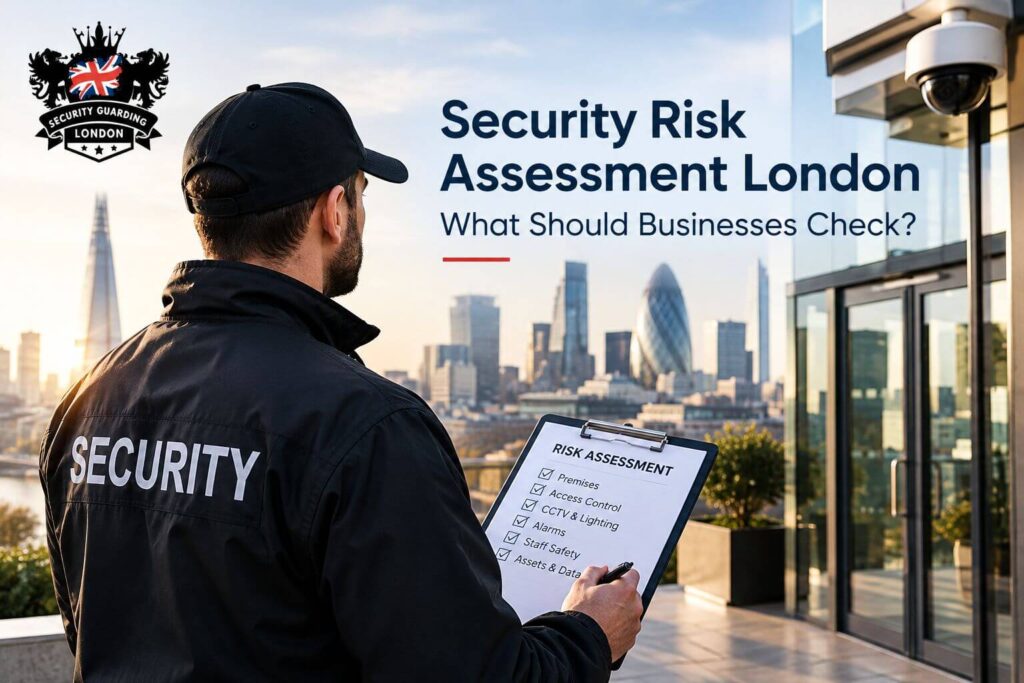
Break-ins, theft and staff safety incidents rarely announce themselves in advance. Most firms only review their protection after something goes wrong, and by then the cost is far higher than prevention would have been. Many owners simply do not know where their weak points sit. A proper security risk assessment London companies can trust changes that, because it shows exactly where criminals could get in. This guide explains what to check and how to act on the findings.
Why a Business Security Assessment Comes First
A business security assessment is a structured review of the threats facing your premises, people, stock and data. It does not mean buying costly equipment straight away. It means identifying what could realistically go wrong, how likely it is, and how badly it would hurt your operations. London sites carry extra pressure, because high footfall, late trading and valuable stock all raise exposure. Once you rank the risks, you can spend your budget where it counts instead of guessing.
What Should You Check During a Risk Assessment?
Work through the following areas one at a time. Each one reveals a different type of weakness.
1. Perimeter and Entry Points
Start outside. Walk the boundary of your site and look at fences, gates, shutters, windows, loading bays and fire exits. Check whether locks work, whether doors close properly, and whether anyone can reach a roof or rear access route unseen. Any security risk assessment London property owners commission should begin here, because most intruders choose the easiest entrance.
2. Access Control
Ask who can enter, when and why. Inspect keys, fobs, visitor logs as well as reception protocols. Employees frequently share keys, fobs, badges or just leave the doors open for their easy going, and these are loopholes. Remove access facilities, such as physical keys, fobs and badges that are given to the departing employees and make sure contractors log in and show their ID.
3. CCTV and Lighting
Cameras only help when they cover the right places and record clearly. Check angles, image quality, storage periods and blind spots. Poor lighting makes even good cameras useless after dark, so test coverage at night as well as during the day. Live monitoring adds another layer, since a trained operator can act the moment something looks wrong.
4. Alarms and Emergency Response
Test your alarm and confirm that someone will respond quickly. A siren alone achieves little if nobody attends. Record who holds keys, how fast they can arrive, and what they do on arrival. Key holding and response services take this burden away from your own team.
5. Staff Behaviour and Procedures
People remain the biggest variable in any security plan. Review induction training, lone-working rules, cash handling and the way employees report suspicious activity. During any security risk assessment London managers organise, ask whether staff know the evacuation routes and who leads in an emergency.
6. Stock, Assets and Data
List your most valuable items, from equipment and inventory to confidential paperwork. Check where each one is stored, who can touch it, and how you would notice a loss. Also look at unattended workstations and unlocked server cupboards, because physical access often leads to data theft.
7. Incident History
Review past thefts, near misses, complaints and insurance claims. Patterns often point directly to the weakest area, such as repeated late-evening theft or regular tailgating at the main door.
How to Turn Findings Into Action
A list of problems helps nobody until you rank it. Score each risk by likelihood and impact, then sort the results into three groups: urgent, important and routine. Begin to take care of the first lot of the items, e.g., broken locks, blind areas of cameras. Schedule the rest across the coming months and set a review date. Treat your security risk assessment London report as a living document, because new tenants, staff changes and building works can alter your risk profile quickly. Insurers also respect written evidence of risk management, which can support better terms at renewal. Reassess at least once a year, and again after any incident.
DIY or Professional Help?
You can complete a basic review internally using the checklist above. However, internal teams often miss problems because they see the site every day. Trained assessors bring fresh eyes, industry benchmarks and knowledge of local crime patterns. Professional security risk assessment services also produce a written report that insurers, landlords and regulators understand. For larger or higher-risk premises, such as warehouses, retail units, construction sites and hotels, an outside business security assessment is the safer route.
How SG London Supports Local Businesses
SG London provides SIA-licensed officers, CCTV monitoring, key holding and response, corporate security, retail security and K9 security units across the capital. The team studies your premises first, then builds a plan around the risks it finds instead of pushing a generic package. A useful security risk assessment London managers can act on needs clear scoring and practical next steps, and a tailored plan follows the initial consultation. Availability runs around the clock, and a hands-on management team answers questions quickly. When you compare security risk assessment services, ask every provider about licensing, response times and reporting standards. SG London answers those questions openly.
Conclusion
A thorough review of entry points, access control, cameras, alarms, people and assets shows where your business is exposed and what to fix first. Commissioning a security risk assessment London specialists can stand behind removes guesswork and gives you evidence to show insurers and landlords. Do not wait for an incident to expose the gaps. Rank your risks, act on them, and put the right protection in place.
Ready to protect your premises? Contact SG London today to book a consultation and receive a tailored security plan.
Frequently Asked Questions
1. What is a business security assessment?
It is a structured review of the threats, weak points and protection measures at your premises.
2. How often should I review my risks?
Review them at least once a year, and again after any incident, move or major change.
3. What do security risk assessment services include?
Normally the services start off with a walk through of premises, then they assess risk levels and deliver a detailed report with suggested actions.
4. How much do security risk assessment services cost?
The price varies with site size and level of complication, hence, it is better to ask for a customized quotation.
5. Is a risk assessment only for large companies?
Absolutely not. Every small shop or office can suffer from theft and safety issues, hence regardless of the size, every company is a target.